Is Your GoHighLevel Account Working Properly? Signs It Needs an Expert Audit
Most agency owners assume their GoHighLevel account is working just because nothing has visibly caught fire. No error messages, no angry client calls, no obvious crash. But "nothing's obviously broken" and "everything's actually working the way it should" are two very different things, and the gap between them is where leads quietly go missing, automations misfire without anyone noticing, and revenue leaks out in ways that never show up as a single dramatic failure.
An expert audit exists to close that gap: a structured look at what's actually happening inside your account versus what you assume is happening. Here's how to tell if you're overdue for one.
Why "Nothing's Broken" Isn't the Same as "Everything's Working"
A workflow can technically run without ever actually converting anyone. A funnel can load fine and still be losing most of its traffic to a confusing layout or a slow, delayed follow-up. A pipeline can look organized while quietly misrepresenting where half your leads actually stand. None of these show up as an error. They show up as results that are just a little worse than they should be, month after month, without an obvious cause.
This is exactly why regular audits matter more than reactive fixes. Waiting for something to visibly break means you've already been losing ground for a while before you noticed.
Signs Your CRM Data Can't Be Trusted
If you've caught yourself second-guessing a lead count or pipeline total because you suspect duplicates or mistagged contacts are skewing it, that's a clear signal. A CRM you don't fully trust means every decision built on top of it, ad spend, staffing, forecasting, is built on a number that's probably wrong. Our guide on signs it's time for a CRM cleanup goes deeper into this specific area if it's resonating.
Signs Your Workflows Aren't Actually Working
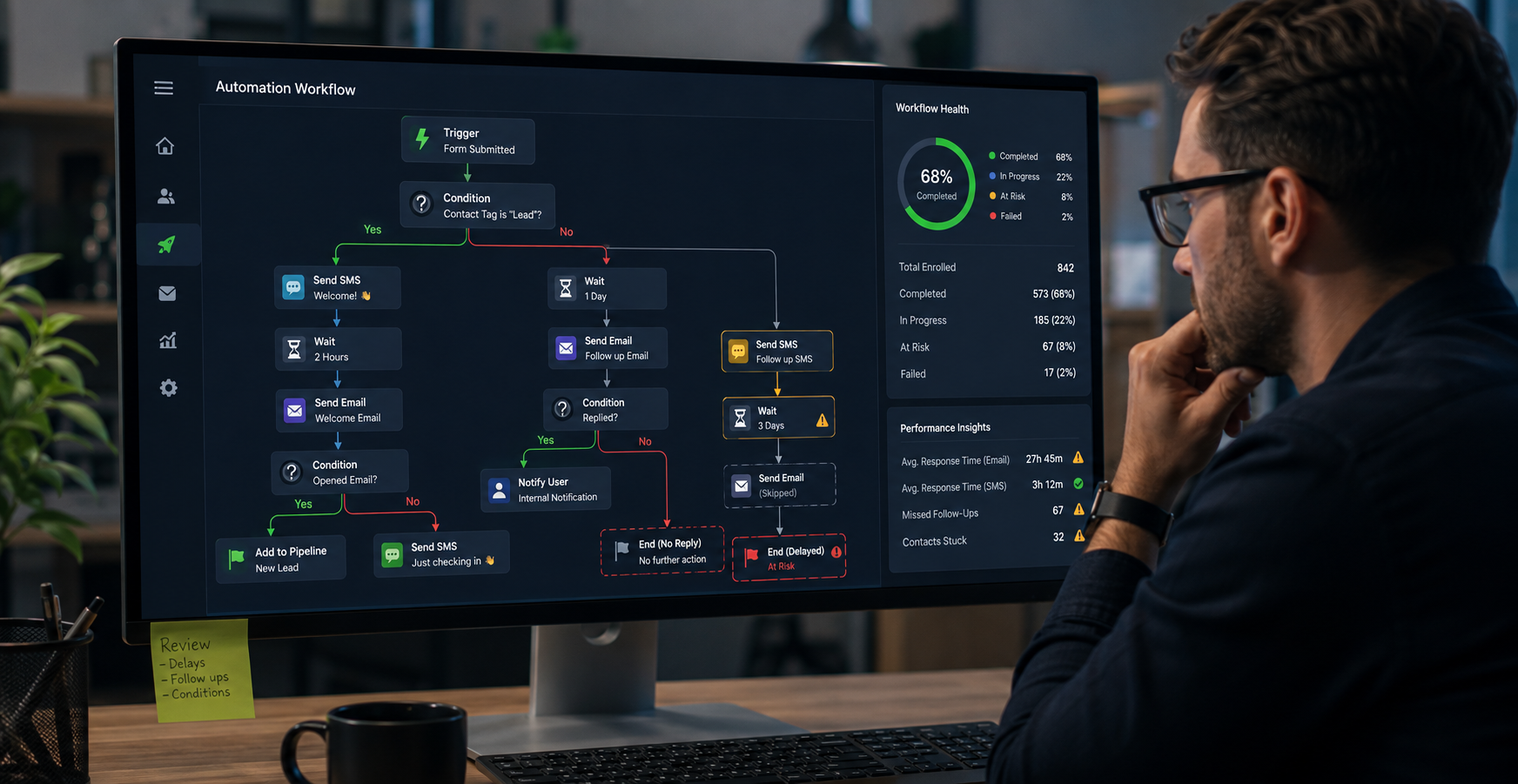
A workflow that fires without errors isn't necessarily doing its job. Watch for leads who mention they never received a follow-up message that should have gone out automatically. Watch for response times that are inconsistent, fast for some leads and hours-late for others, with no clear pattern explaining why. And watch for workflows that were built once, a year or more ago, and never revisited even though your offer or process has changed since then.
Signs Your Funnels Are Quietly Underperforming
A funnel doesn't need to be broken to be underperforming. If conversion rates have been flat or declining without an obvious cause, if you've never actually checked how the funnel renders on mobile, or if there's no automated follow-up triggered the moment someone converts, the funnel is likely leaving results on the table even though it's technically live and functional.
Signs Your Pipeline Doesn't Reflect Reality
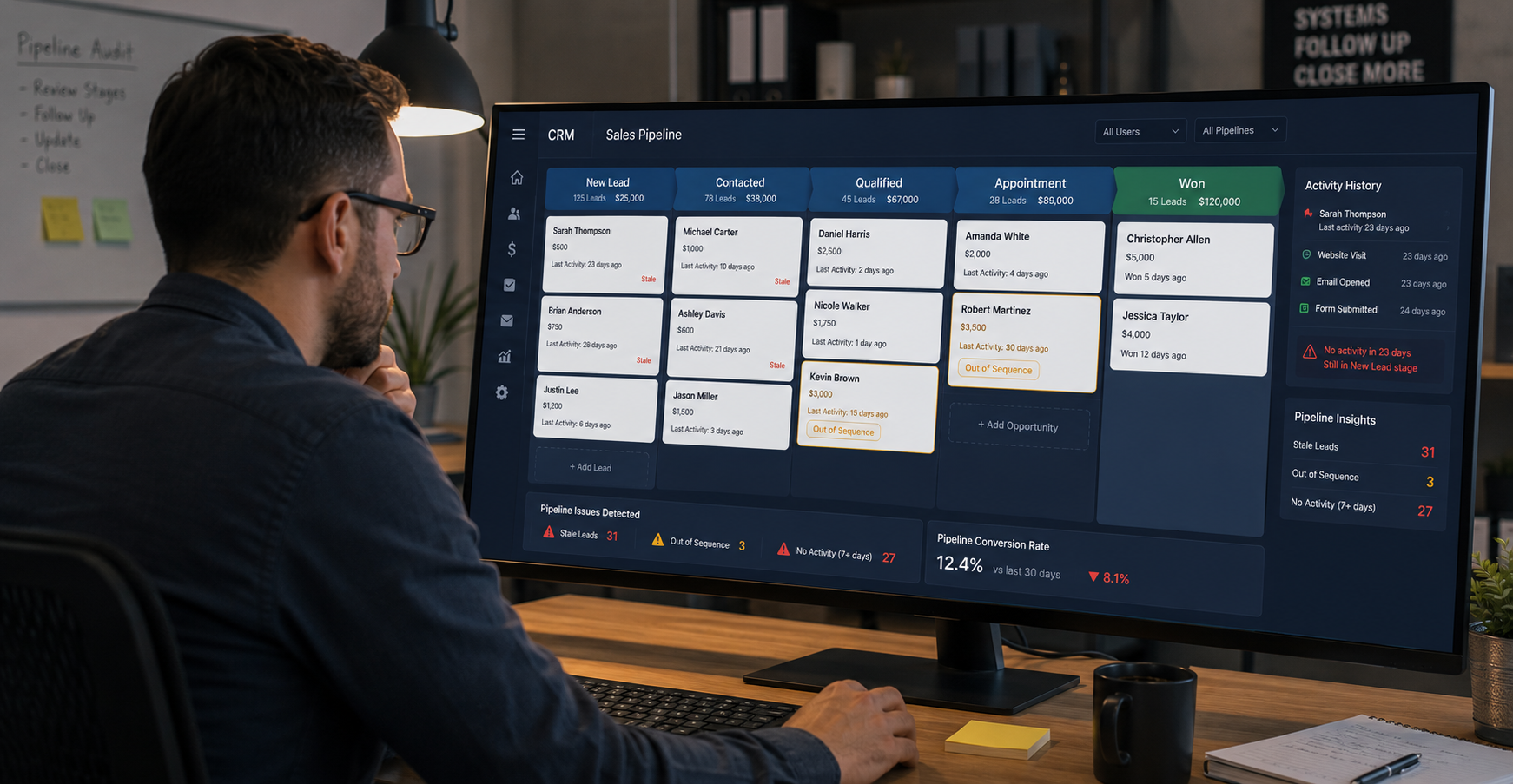
If contacts are sitting in stages that no longer describe where they actually are, a lead marked "New" weeks after the first conversation, your pipeline has stopped being a reliable source of truth. At that point, it's not helping anyone prioritize their day, it's just a list with columns.
Signs Your SMS and Email Aren't Coordinated
If your text messages and emails are being sent by different processes that don't reference each other, contacts can end up over-messaged from one channel and under-messaged from another, or receiving conflicting information depending on which automation happened to fire first. A properly audited account treats SMS and email as one coordinated system, not two separate efforts.
Signs Nobody Fully Understands the Account Anymore
If onboarding a new team member requires a disclaimer like "ignore that pipeline, it's outdated" or "don't worry about most of those workflows, we're not sure what half of them do," that's one of the clearest signs an audit is overdue. An account that even your own team can't confidently navigate has usually accumulated enough undocumented complexity that small issues are very likely hiding inside it.
What a GoHighLevel Audit Actually Involves
A proper audit isn't a quick scroll through your dashboard. It typically starts with a full review of the existing setup: pipelines, custom fields, tags, calendars, and account structure, followed by a check of active workflows to see what's currently running, what's paused, and what's silently failing. From there, a thorough audit reviews sub-account configurations and permissions, tests key funnels across devices, and checks whether SMS and email sequences are actually coordinated or working against each other. The goal isn't just to list problems, it's to understand why the account got to its current state, so fixes address the actual cause rather than just the symptoms.

What Happens After the Audit
A good audit ends with a clear, prioritized plan, not just a list of everything that's wrong. The highest-impact issues, usually the ones actively costing leads or revenue, get addressed first. Lower-priority cleanup and optimization work gets scheduled afterward, so the account improves in a logical order instead of everything getting tackled at once and nothing getting finished properly.
What Agency Owners Say
What Does an Audit Cost?
An audit is typically the starting point of a broader engagement rather than a standalone service billed separately. As a current example, GHL Plugins' dedicated VA program runs a flat $1,500 a month for 40 hours a week, with no long-term contract, and an account audit is typically part of how that engagement begins, understanding what exists before anything gets changed. That sits within the roughly $1,200 to $2,500 a month range typical of dedicated, team-trained VA programs.

Frequently Asked Questions
Conclusion
A GoHighLevel account that isn't visibly broken can still be quietly underperforming in ways that cost real leads and revenue every month. An expert audit is how you find out the difference between "nothing's on fire" and "everything's actually working," before those quiet gaps add up to something much harder to fix later.